Conical Centrifuge Tubes & Microcentrifuge Tubes
15 mL and 50 mL conical centrifuge tubes rated to 20,000 × g, and 1.5, 2.0 and 5.0 mL microcentrifuge tubes rated to 25,000 × g — graduated, with a writing area, sterile options available, and OEM/ODM branding from our Tianjin cleanroom.
The tube, not the centrifuge, decides whether the pellet survives
A rotor can be perfectly balanced and perfectly programmed and still lose the sample — if the tube deforms under load, if the cap lifts at pressure, or if the wall thins at the hinge. Centrifugal force scales with radius and rotor speed: a full 50 mL tube at 20,000 × g loads its own base with close to a tonne of force, and every millilitre of that load passes through the wall.
BUNSEN moulds centrifuge tubes from polypropylene with uniform wall thickness, so the conical base deforms predictably instead of thinning at a single point. Batches are checked for dimensional consistency, seal integrity and clarity, and sterile formats are processed in a 100,000-class cleanroom. The range covers 15 mL and 50 mL conical tubes plus 1.5, 2.0 and 5.0 mL microcentrifuge tubes — sterile or non-sterile, bulk or racked, with OEM/ODM options for colour, printing, barcodes and packaging.
Looking for the other half of the workflow? Our filter and low-retention pipette tips are matched to the same volume range, so sample transfer and sample recovery can be specified together.
Conical centrifuge tubes — 15 mL and 50 mL, rated to 20,000 × g
The conical format is the workhorse of sample preparation. The taper collects cells, precipitate or debris into a compact pellet at the tip, so the supernatant can be poured or aspirated off without disturbing it, and the pellet can be resuspended in a volume far smaller than the starting volume.
BUNSEN conical tubes are moulded in polypropylene with a uniform wall and high clarity, so pellet formation and phase boundaries stay visible against the tube wall. Sterile and self-standing formats are both available, and the range tolerates storage at −80 °C and autoclaving at 121 °C.
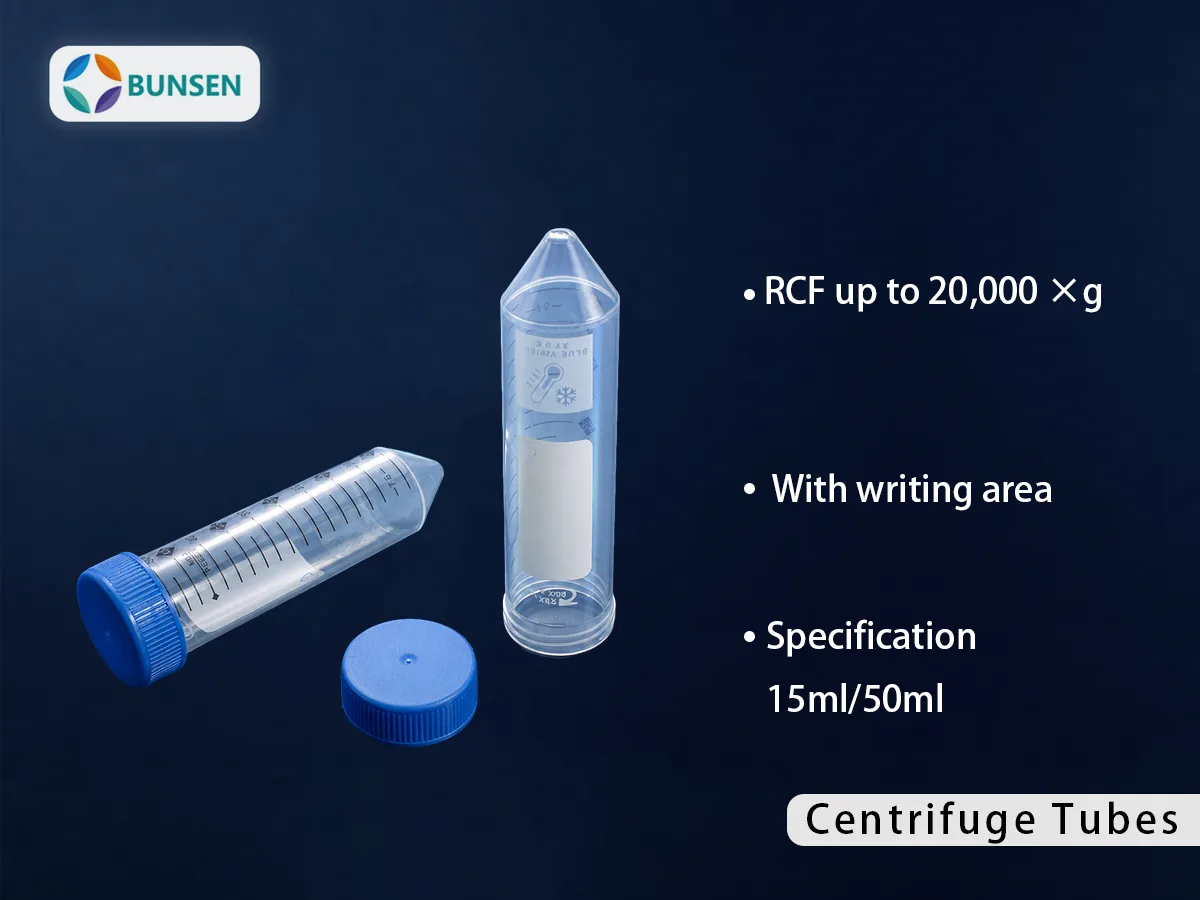
| Volume | 15 mL · 50 mL |
|---|---|
| Bottom | Conical |
| Material | Polypropylene (PP) |
| Max RCF | 20,000 × g |
| Graduations | Printed scale and volume markings on the tube wall |
| Writing area | Frosted panel for sample identification |
| Cap | Screw cap |
| Sterility | Sterile and non-sterile formats |
| Standing | Self-standing option available |
| Seal | Leak-proof and airtight |
| Temperature | Storage at −80 °C; autoclavable at 121 °C |
Graduations and a writing area — read the volume without a cylinder
A graduated centrifuge tube carries its own scale, so you can confirm the volume after decanting, top up to a mark, or record exactly how much supernatant was removed — without transferring the sample to a measuring cylinder and losing part of the pellet in the process. On the BUNSEN conical tubes the graduations are printed directly on the wall, with a frosted writing panel beside them for the sample name, date and run conditions.
Screw cap and self-standing base
The screw cap threads onto the neck and seals the tube for transport, freeze storage and vortexing, so a sample can leave the rotor and go straight into the freezer without being decanted. The self-standing variant has a moulded skirt that lets the tube stand upright on the bench, which keeps the pellet at the base instead of letting it slide down the inside wall while the tube lies on its side.
Microcentrifuge tubes — 1.5, 2.0 and 5.0 mL, rated to 25,000 × g
Microcentrifuge tubes take the volumes that are too small for a conical tube but too important to lose. They are the standard vessel for nucleic acid precipitation, protein work, enzymatic reactions and cell pelleting at bench scale, and they are rated considerably higher than the larger conical format because the load is smaller and the wall is proportionally thicker.
BUNSEN microcentrifuge tubes combine a conical bottom for complete sample recovery with a hinged cap that latches shut, clear graduations up the side and a writing area. They are RNase-, DNase- and pyrogen-free, and available in a sterile format for cell and nucleic acid work.
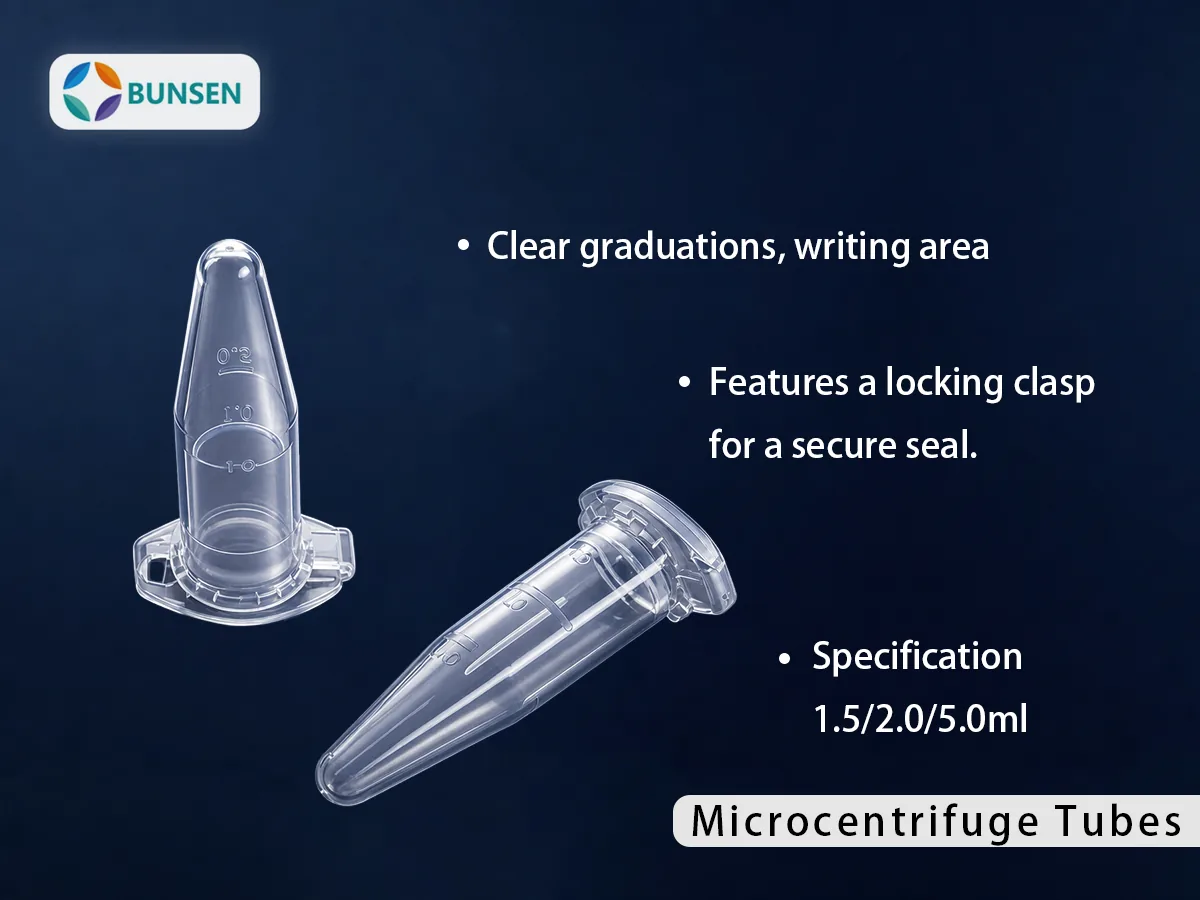
| Volume | 1.5 mL · 2.0 mL · 5.0 mL |
|---|---|
| Bottom | Conical |
| Max RCF | 25,000 × g |
| Graduations | Clear printed graduations up the tube wall |
| Writing area | Yes |
| Cap | Hinged cap with locking clasp |
| Seal | Secure seal held by the locking clasp |
| Nuclease status | RNase-free, DNase-free and pyrogen-free |
| Sterility | Sterile format available |
The locking clasp — why a hinged cap needs a latch
A hinged cap is convenient, but convenience is exactly the problem at high speed: a cap that only rests closed will lift under pressure and release aerosol into the rotor. The BUNSEN microcentrifuge tube closes onto a locking clasp that holds the lid down mechanically, so the seal is maintained through boiling steps, vortexing and centrifugation rather than relying on friction alone.
Conical bottom and clear graduations
The conical base concentrates the pellet into the smallest possible volume, which is what makes complete recovery of a nucleic acid or protein pellet practical at 1.5 mL scale. Clear graduations up the wall let you check the recovery volume and resuspend to a defined concentration without moving the sample to another vessel.
Sterile or non-sterile — and when it actually matters
Sterility only earns its cost when the sample is living or when the downstream assay is sensitive to microbial load. Cell culture, primary cell isolation, blood and serum separation, and any workflow that ends in a sterility test need a sterile tube. Nucleic acid work usually needs nuclease-free surfaces rather than sterility as such, while general sample preparation, environmental sampling and non-sterile dilution steps are served perfectly well by a non-sterile tube.
Both BUNSEN formats are available sterile and non-sterile, so a protocol can be specified tube by tube instead of buying the most expensive option everywhere.
Gamma irradiation or autoclaving — two different jobs
Gamma irradiation sterilises the tube in its packaging, so it arrives ready to use and can be opened inside a clean bench. Autoclaving sterilises the tube at the point of use, at 121 °C, and is the right choice for reusable workflows and for tubes that will be filled in a non-sterile environment and sterilised afterwards. Repeated autoclaving gradually reduces the mechanical strength of polypropylene, so a tube used for high-speed centrifugation should be replaced rather than re-sterilised indefinitely.
Which tube for which sample — a selection guide
Choosing the tube is mostly a question of starting volume and the force required to clear the supernatant. If you are also selecting the instrument, our tabletop centrifuge takes a 6 × 15 mL rotor with optional blood-tube and cryovial adapters.
| Workflow | Tube | Why |
|---|---|---|
| Cell culture harvest, 10–50 mL | 50 mL conical | Holds the whole flask volume; the conical base pellets cells in one place for a small-volume resuspension. |
| Culture harvest, 5–15 mL | 15 mL conical | Fits the standard 15 mL rotor position without occupying a 50 mL adapter. |
| Serum or plasma separation | 15 mL conical | Low-speed spinning of whole blood; screw cap keeps the separated fractions sealed for transport. |
| Nucleic acid precipitation | 1.5 / 2.0 mL microcentrifuge | 25,000 × g drives the pellet to a tight point; graduations allow direct resuspension. |
| Protein work above 2 mL | 5.0 mL microcentrifuge | Same high-force rating as the smaller tubes with extra headroom for washes. |
| Freezer storage at −80 °C | Screw-cap conical or locking-clasp microcentrifuge | A mechanically held seal stays closed when the contents expand on freezing. |
How to balance tubes in a centrifuge — and what happens if you don't
An unbalanced rotor converts rotational energy into vibration. At low speed that means a noisy run and a disturbed pellet; at high speed it means bearing wear, a cracked rotor, or a tube that leaves its bucket. The rule is simple: tubes opposite each other must have the same mass, the same centre of gravity and the same type.
In practice that means equal fill volume, not equal sample volume — top up the lighter tube with water or buffer to match. With an odd number of samples, prepare a balance tube of the identical type and fill it to the same mark. Never balance a conical tube against a microcentrifuge tube, even if the volumes look similar; their mass distribution is different. And never run a swing-out rotor with a bucket removed to compensate for an odd number of tubes.
Static-angle versus swing-out rotors
A fixed-angle rotor holds the tube at a constant angle, so the pellet is driven down and to the side of the wall and forms a streak rather than a spot. A swing-out rotor brings the tube horizontal during the run, so the pellet lands flat in the centre of the base — easier to see, easier to resuspend, and the usual choice when complete recovery matters. Both need balanced loads; the swing-out rotor simply makes imbalance more visible.
Centrifuge tube sizes — a field guide
Tube size names refer to the nominal capacity at the rim, not to a working volume. Filling to the nominal mark leaves no headspace, so in practice a tube is filled somewhat below its nameplate — and never above the maximum mark printed by the manufacturer.
| Nominal size | Typical working volume | Usual work | Format |
|---|---|---|---|
| 1.5 mL | 1.0–1.5 mL | Nucleic acid precipitation, enzymatic reactions | Microcentrifuge |
| 2.0 mL | 1.5–2.0 mL | Protein work, cell pelleting at bench scale | Microcentrifuge |
| 5.0 mL | 3.0–5.0 mL | Larger micro volumes, wash steps | Microcentrifuge |
| 15 mL | 10–12 mL | Cell culture harvest, blood separation | Conical |
| 50 mL | 35–45 mL | Bulk culture harvest, large sample prep | Conical |
Why a 15 mL tube is usually filled to about 12 mL
Leaving a fifth of the tube empty does two things. It gives the liquid somewhere to move when the rotor accelerates and decelerates, which keeps the tube from being loaded hydraulically against the cap, and it leaves room for foaming when the contents are vortexed or shaken. Filling to the very top is the most common cause of a leaking cap in a conical tube.
OEM / ODM centrifuge tubes for your own brand
Centrifuge tubes are one of the most frequently rebranded consumables in the laboratory, and both formats can be produced to your specification rather than relabelled from stock.
Stock
15 mL and 50 mL conical tubes and 1.5, 2.0 and 5.0 mL microcentrifuge tubes are held in stock and ship within 1–2 working days, from a single pack with no minimum.
Custom
OEM/ODM orders can be delivered in as fast as 15 working days. Options include tube and cap colour, printed or laser-marked logo, barcode or QR code, and bag or rack packaging. MOQ is quoted per project.
Export
We ship to the EU, North America, Southeast Asia, the Middle East and South America, and prepare the trade documents your customs authority requires.
Centrifuge tubes — frequently asked questions
What centrifuge tube sizes does BUNSEN supply?
15 mL and 50 mL conical centrifuge tubes, and 1.5 mL, 2.0 mL and 5.0 mL microcentrifuge tubes. Conical tubes are available sterile or non-sterile, with a self-standing option; microcentrifuge tubes are supplied with a hinged locking-clasp cap.
What is the difference between a conical centrifuge tube and a round-bottom tube?
A conical tube tapers to a small point, so a pellet collects in a tight spot at the base and is easy to see and resuspend in a small volume. A round-bottom tube has a hemispherical base, which spreads the pellet over a wider area. The BUNSEN standard range is conical-bottom — tell us if your protocol needs a round-bottom format.
What does a graduated centrifuge tube mean?
A graduated centrifuge tube carries a printed scale on the tube wall, so volume can be read without a separate measuring cylinder. BUNSEN conical 15 mL and 50 mL tubes are printed with graduation marks and numbers, and the microcentrifuge tubes carry clear graduations up the side.
What centrifugal force can BUNSEN centrifuge tubes withstand?
The 15 mL and 50 mL conical centrifuge tubes are rated to 20,000 × g. The microcentrifuge tubes are rated to 25,000 × g. Always check the rating against your rotor and run parameters before centrifuging, and never exceed the rated fill volume.
Are your centrifuge tubes sterile?
Both formats are available sterile. Conical 15 mL and 50 mL tubes are supplied in sterile and non-sterile formats, and microcentrifuge tubes are also available sterile. Microcentrifuge tubes are additionally RNase-, DNase- and pyrogen-free.
Can centrifuge tubes be autoclaved?
The 15 mL and 50 mL polypropylene conical tubes withstand autoclaving at 121 °C. Repeated autoclaving gradually reduces mechanical strength, so tubes used for high-speed centrifugation should be replaced rather than repeatedly re-sterilised.
Can I store samples at −80 °C in centrifuge tubes?
Yes. The polypropylene conical tubes are rated for storage at −80 °C. Leave headspace for expansion if the sample may freeze, and use a screw cap or locking clasp so the seal is not forced open.
How do I balance tubes in a centrifuge?
Load tubes in opposite positions so their combined mass and centre of gravity match: equal volume, equal tube type and equal cap. With an odd number of samples, prepare a balance tube of the same type filled with water to the same volume. Never balance a conical tube against a microcentrifuge tube, and never run a swing-out rotor with a bucket missing.
What is the difference between a centrifuge tube and a microcentrifuge tube?
They describe the same product family at different scales. A centrifuge tube usually means the larger 15 mL and 50 mL conical format used for cell culture, blood separation and bulk sample work. A microcentrifuge tube means the 1.5 to 5.0 mL format used for nucleic acid and protein work at higher relative centrifugal force.
Do you supply bulk centrifuge tubes, and what is the minimum order quantity?
Yes. Bulk and racked formats are both available. Stock items can be ordered from a single pack; for OEM/ODM orders the minimum order quantity depends on the specification, such as colour, printing, barcode and packaging, and is quoted per project.
Can you print our logo, or add barcodes and custom packaging?
Yes. OEM/ODM options include tube and cap colour, printed or laser-marked logo, barcode or QR code, custom bag or rack packaging, and a sterilisation format that matches your market.
What are the lead times for stock and custom centrifuge tubes?
Stock items normally ship within 1–2 working days after the order is confirmed. Custom orders are tracked end-to-end and can be delivered in as fast as 15 working days.
Need a sample tube or a quotation?
Tell us the volume, format and sterility requirement — we will confirm the specification and send a trial pack.
Request a quote or sample →